
Choosing between an electric bike and a petrol bike is no longer simply a question of whether electricity is cheaper than petrol. In 2026, Indian buyers have more electric two-wheelers to choose from, but petrol motorcycles and scooters still offer advantages in refueling, highway travel and service availability.
The better choice depends on how you actually use your two-wheeler.
Your daily distance, access to charging, purchase budget, road conditions, highway usage, expected ownership period and local service network can matter more than the powertrain itself.
For example, a city commuter who rides 30–50 km a day and can charge at home may benefit greatly from an EV. Someone who regularly travels 150–300 km between cities may still find a petrol motorcycle considerably easier to live with.
So, Electric Bike vs Petrol Bike is really a question of which powertrain fits your routine.
Quick Verdict Electric Bike vs Petrol Bike
| Category | Electric | Petrol |
|---|---|---|
| Best for city commuting | Electric | Good |
| Best for long-distance riding | Good for selected models/routes | Petrol |
| Lowest running cost | Electric | Petrol |
| Fastest refueling | — | Petrol |
| Lowest routine powertrain maintenance | Electric | Petrol |
| Best without home charging | Limited | Petrol |
| Highway convenience | Petrol generally easier | Petrol |
| Predictable daily commuting | Electric | Good |
| Performance options | Increasing rapidly | More established |
| Long-term urban use | Electric can be excellent | Good |
These are broad recommendations. The actual result can change considerably between individual models.
📌 Read more:
- Jawa 42 All Stars Launched in India: Price, Specs & Features
- Electric Bike vs Petrol Bike: Pros, Cons & Ownership Cost 2026
- Tesla Balance Bike for Kids: Price, Features, Specifications & Why It Sold Out Instantly
- Yamaha Aerox E Price, Range, Features, Specifications & Review
- Revolt RVX Review 2026: Price, Range, Specifications, Features & Is It Worth Buying?
Electric Bike vs Petrol Bike: At a Glance
The Electric Motorcycle vs Petrol Motorcycle comparison becomes particularly important for buyers who regularly use highways or carry passengers. Similarly, an EV Bike vs Petrol Bike comparison should include not only performance but also charging access and long-term ownership.
| Factor | Electric Two-Wheeler | Petrol Two-Wheeler |
| Purchase price | Can be higher or similar depending on model | Wide range, including inexpensive models |
| Running cost | Usually much lower | Higher because of petrol |
| Refueling/charging | Requires charging time | Usually a few minutes |
| Range | Model- and usage-dependent | Generally easy to extend with fuel stops |
| Performance | Instant motor response | Engine power builds with rpm |
| Maintenance | Fewer conventional powertrain parts | More mechanical maintenance |
| Battery/engine | Battery and electric motor | Engine, fuel system and transmission |
| Noise | Very quiet | Engine noise and vibration |
| Service | EV-trained service network required | Mature nationwide network |
| Highway use | Depends heavily on range and charging | Generally convenient |
| City use | Excellent for predictable commuting | Very practical |
| Resale | Battery health and brand support matter | Engine condition and market demand matter |
| Warranty | Battery warranty is particularly important | Engine/vehicle warranty matters |
| Environmental impact | No tailpipe emissions | Produces tailpipe emissions |
| Best use case | Urban commuting and predictable daily trips | Mixed use and long-distance travel |
How Electric Bikes Work
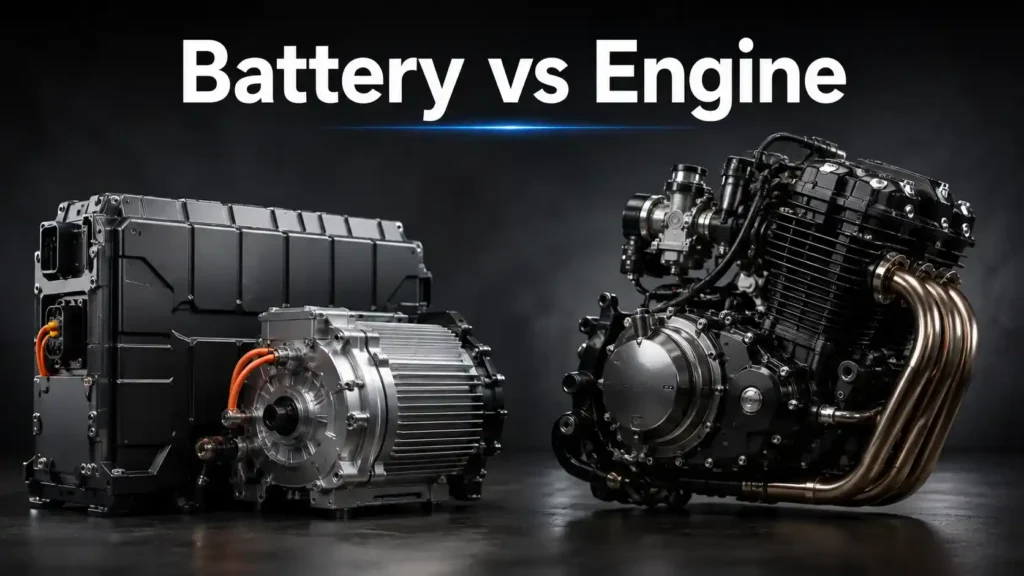
An electric two-wheeler uses electricity stored in a battery to power an electric motor. The main components are:
- Battery pack
- Electric motor
- Motor controller
- Battery Management System (BMS)
- Charger
- Regenerative braking, where supported
- Transmission or reduction drive, depending on design
The BMS monitors battery operation and helps manage charging, temperature and other operating parameters.
Electric scooters usually use a relatively simple transmission arrangement, while electric motorcycles can use different motor and drivetrain layouts depending on the manufacturer.
The important difference for the rider is simplicity: there is no conventional petrol engine, engine oil or exhaust system.
How Petrol Bikes Work
A petrol motorcycle or scooter uses an internal-combustion engine. Its main components include:
- Petrol tank
- Engine
- Fuel-injection system
- Clutch, where applicable
- Transmission
- Exhaust system
- Engine oil
- Cooling system
Petrol remains practical because fuel stations are widely available and refueling takes only a few minutes. For riders who frequently travel outside cities, that convenience can outweigh the higher running cost.
Purchase Price
Purchase price is where comparisons can become misleading. Electric two-wheelers are available across several price ranges, from relatively affordable scooters to premium performance-oriented motorcycles and scooters.
For example, TVS currently lists the iQube in several battery configurations. Its official India page shows ex-showroom prices including charger and GST ranging from about ₹1.20 lakh for the 2.2-kWh version to ₹1.46 lakh for the 5.3-kWh ST version before applicable incentives or other charges. The same page lists IDC ranges from 94 km to 212 km depending on variant.
Ola’s current Delhi pricing page similarly lists multiple S1 configurations, including the S1 Pro 3-kWh and 4-kWh versions and higher-capacity S1 Pro+ models.
Petrol motorcycles can also start substantially lower. For example, Bajaj currently lists the Pulsar 125 from ₹87,255 ex-showroom Delhi on its model page, while its separate price page lists ₹92,111 for a specified configuration. This illustrates why buyers should always check the exact variant and current city pricing rather than relying on an old starting-price figure.
Important: ex-showroom price is not the same as the final on-road price.
Registration, insurance, road tax, accessories, financing and local charges can change the amount you actually pay.
Government incentives also need careful checking. The PM E-DRIVE programme has supported eligible electric two-wheelers, but eligibility and registration periods have changed over time. Official government notifications should be checked at the time of purchase rather than assuming that an old subsidy automatically applies.
Read: Best Smartphones Launched in June 2026
Running Cost: The Biggest Difference
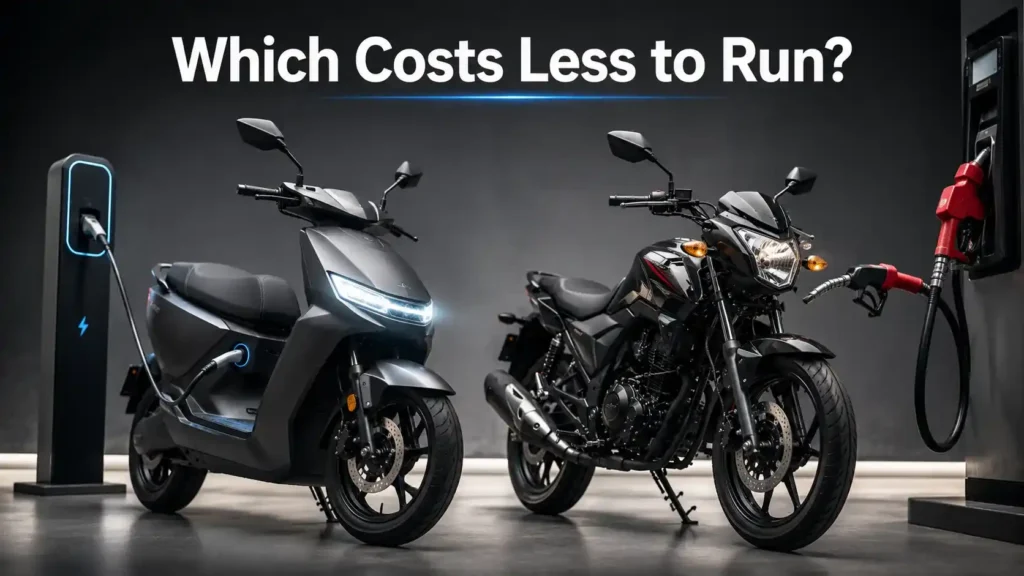
This is where electric two-wheelers have their strongest advantage. Petrol costs depend on fuel price and mileage. Electric running costs depend mainly on electricity price and energy consumption.
Illustrative example
Assume a rider travels 1,000 km per month. For this example, assume:
- Electricity: ₹8 per kWh
- EV energy consumption including charging losses: 3 kWh/100 km
- Petrol: ₹102.12/litre
- Petrol efficiency: 45 km/litre
The petrol figure is based on the Delhi petrol retail price recorded by PPAC in July 2026; actual prices vary by location and can change.
Electric
- 3 kWh × ₹8 = ₹24 per 100 km
- For 1,000 km: ₹240 per month
Petrol
- 1,000 ÷ 45 = 22.22 litres
- 22.22 × ₹102.12 = approximately ₹2,269 per month
Difference: Approximate monthly energy/fuel saving: ₹2,029
Annual saving: About ₹24,350
Electric Bike Running Cost is generally much lower than the Petrol Bike Running Cost when the vehicle is charged at a reasonable electricity tariff and used regularly. For buyers researching EV running cost India, however, the calculation should include charging losses and the rider’s actual electricity tariff.
This is why an EV can become financially attractive for a high-mileage commuter even when its purchase price is higher.
Read: Best Laptop Under ₹50000 in India 2026 | Top 10 Latest Picks
5-Year Ownership Cost
A proper Total Cost of Ownership calculation should include more than fuel.
TCO formula
Purchase price:
- Electricity/petrol
- Maintenance
- Insurance
- Charging equipment
- Battery-related costs where applicable
− Incentives
− Resale value
Consider this purely illustrative example:
| Cost over 5 years | Electric | Petrol |
| Purchase price assumption | ₹1,20,000 | ₹1,00,000 |
| Energy/fuel | ₹14,400 | ₹1,36,160 |
| Maintenance assumption | ₹15,000 | ₹30,000 |
| Insurance assumption | ₹27,000 | ₹27,000 |
| Charging equipment | ₹5,000 | — |
| Resale assumption | −₹35,000 | −₹50,000 |
| Illustrative TCO | ₹1,46,400 | ₹2,43,160 |
This assumes 1,000 km per month for five years. These maintenance, insurance, charging and resale numbers are illustrative assumptions, not market averages or manufacturer quotes.
The important lesson is that a lower running cost does not automatically make an EV cheaper. A large purchase-price difference, expensive insurance, charging installation or future battery-related expense can change the result.
Charging vs Refueling
Electric
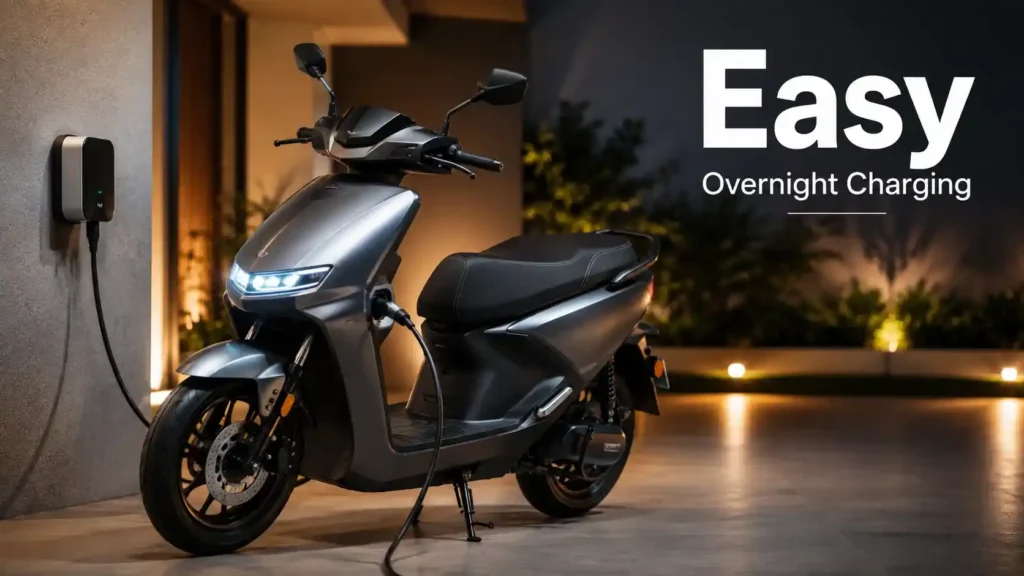
Electric two-wheelers can be charged:
- At home
- At work
- At public charging points
- Overnight
- Using portable chargers on compatible models
- Using faster charging systems where supported
Charging access is one of the most important EV buying decisions.
TVS, for example, currently advertises more than 2,000 public charging locations for the iQube and lists different charging times depending on battery size. Its current iQube range includes 2.2-kWh, 3.1-kWh, 3.5-kWh, 4.7-kWh and 5.3-kWh variants.
By comparison, petrol refueling usually takes only a few minutes. That difference becomes particularly important for touring and long-distance riders.
Range and Real-World Usage
Never treat claimed range as guaranteed real-world range. Manufacturers publish tested or claimed figures under specified conditions. Your actual range can be affected by:
- Riding speed
- Rider weight
- Passenger weight
- Traffic
- Acceleration
- Riding mode
- Tyre pressure
- Road gradient
- Weather
- Battery temperature
- Use of accessories
For example, TVS currently lists up to 212 km IDC range for one iQube configuration, while Ola lists up to 320 km IDC range for its S1 Pro+ 5.2-kWh configuration. These are manufacturer/IDC figures and should not be treated as guaranteed everyday range.
When shopping, leave a practical buffer between your normal daily distance and the claimed range.
Performance
Electric motors deliver torque very differently from petrol engines. An EV can feel immediately responsive when you open the throttle because the motor does not need to build revs in the same way as an internal-combustion engine.
Petrol bikes deliver power through an engine and transmission. Gear selection, engine rpm and clutch operation influence how the motorcycle responds.
Neither system is automatically faster.
For example, Ola currently lists the S1 Pro+ 5.2-kWh with a 130 km/h claimed top speed and 2.1-second 0–40 km/h acceleration, while TVS’s iQube is designed more around everyday scooter use, with its variants reaching up to 82 km/h.
A petrol motorcycle can still be the better choice if you need sustained highway performance, greater touring flexibility or a traditional motorcycle riding experience.
Maintenance
Electric
An EV generally eliminates several conventional engine-related maintenance items. You normally do not have:
- Engine oil
- Oil filter
- Spark plug
- Engine air-intake maintenance in the conventional sense
- Clutch maintenance on many scooters
- Exhaust-system maintenance
But EVs still require maintenance for:
- Brakes
- Tyres
- Suspension
- Bearings
- Electrical components
- Software
- Cooling systems, where fitted
- Battery and charging systems
So electric does not mean maintenance-free.
Petrol
Petrol vehicles require additional powertrain maintenance, including items such as:
- Engine oil
- Oil filter
- Air filter
- Spark plug
- Clutch
- Chain and sprockets on motorcycles
- Transmission components
- Engine-related inspections
TVS, for example, currently states a five-year/60,000-km standard warranty for its motorcycles, subject to conditions, illustrating that petrol motorcycle ownership continues to involve a conventional mechanical powertrain.
Read: Best EVs Under ₹20 Lakh in India 2026: Top Budget EV Cars
Battery Life and Warranty
Battery warranty is one of the most important things to check before buying an EV.
Do not ask only: How many years will the battery last?
Instead ask:
- What is the battery warranty?
- What kilometre limit applies?
- What does the warranty actually cover?
- Is capacity degradation covered?
- What happens after warranty expiry?
- How much would replacement cost?
- Can the warranty transfer to another owner?
Warranty terms vary significantly.
TVS currently lists a three-year/50,000-km warranty for the iQube vehicle and battery, although its FAQ specifies different kilometre limits for the 2.2-kWh variant and other variants.
Ola currently lists a base battery warranty of three years/50,000 km on its S1 warranty information, with additional warranty products available on eligible models.
Ather’s current information also shows model- and package-dependent warranty coverage, with options extending battery coverage to five years/60,000 km or beyond.
Therefore, there is no single battery-life number that applies to every electric bike.
📌 Read more:
- 2025 Hyundai Aura SX: Ultimate Review of Features & Mileage
- Apple Event iPhone 18 Pro and iPhone 18 Pro Max, iPhone Duo & Apple Watch Series 12, Apple Watch Ultra 4 and AirPods 5.
- Apple iPhone 17 Series Features & Price in India 2025-26
- Best Camera Phones 2026: Top 5 Phones for Photography and Video
- Best Camera Phones Under ₹30K in 2026: Real Camera Comparison
- Best EVs Under ₹20 Lakh in India 2026: Top Budget EV Cars
Long-Distance and Highway Riding
Petrol remains the easier choice for frequent long-distance travel.
Why? You can usually:
- Stop at widely available fuel stations
- Refuel quickly
- Continue immediately
- Travel through areas with limited EV infrastructure
Electric motorcycles can absolutely be used for longer trips, but route planning becomes more important. You need to consider:
- Available chargers
- Charging speed
- Charger compatibility
- Expected range
- Backup charging options
- Weather
- Highway speed
For someone who travels 200 km every weekend, petrol may be more convenient. For someone who travels 40 km every weekday and rarely leaves the city, that advantage may not matter.
City Commuting
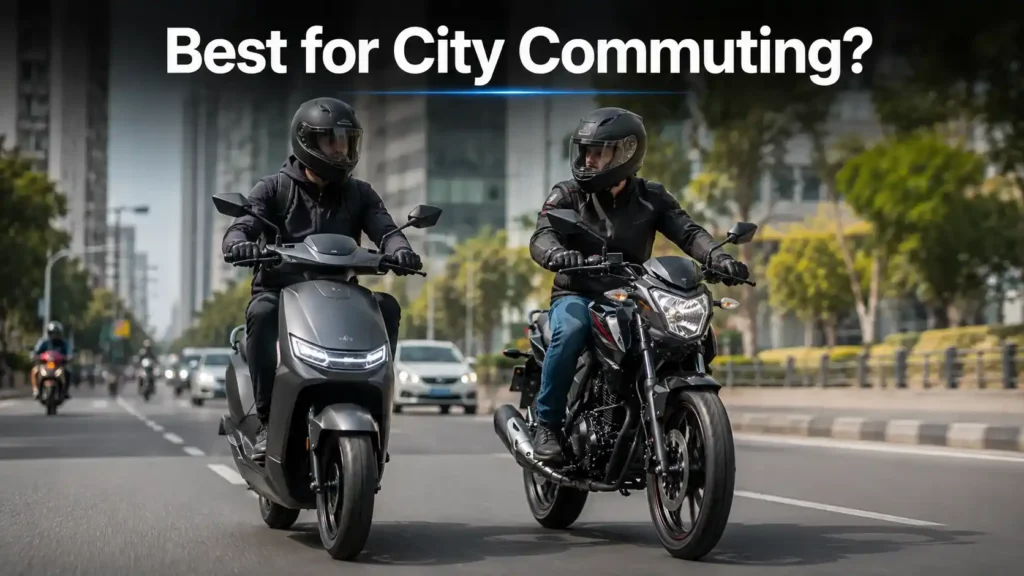
This is where electric two-wheelers are particularly compelling. For:
- Office commuting
- College
- Grocery trips
- Stop-and-go traffic
- Short urban journeys
- Daily predictable routes
an EV can provide low energy costs, smooth acceleration and convenient overnight charging. Regenerative braking can also recover some energy in compatible vehicles. A petrol bike remains equally practical if the rider cannot charge at home or work.
Riding Experience
Electric two-wheelers generally feel:
- Quieter
- Smoother
- More immediate
- Easier in stop-and-go traffic
- Free from conventional gear shifting on many models
Petrol motorcycles provide:
- Engine sound
- Gear changes
- Clutch operation
- Engine braking characteristics
- A more traditional motorcycle feel
For some riders, this emotional and mechanical connection is part of the reason they prefer petrol motorcycles.
Safety
Safety depends on the individual vehicle, not simply whether it is electric or petrol. Look for:
- ABS
- CBS where applicable
- ESC on models that offer it
- Traction control where available
- Good tyres
- Strong braking hardware
- Adequate lighting
- Stable chassis
- Good build quality
- Battery protection and thermal management on EVs
Do not assume that every EV has better safety equipment than every petrol bike. Always compare the exact variant.
Environmental Impact
Electric vehicles have an important advantage because they produce no tailpipe emissions while being driven.
However, that does not mean an EV has zero environmental impact. Its overall footprint also involves:
- Battery manufacturing
- Mineral extraction
- Vehicle manufacturing
- Electricity generation
- Charging losses
- End-of-life recycling
Petrol vehicles involve:
- Fuel extraction
- Refining
- Transportation
- Combustion
- Tailpipe emissions
- Vehicle manufacturing
The lifetime environmental advantage of an EV therefore depends partly on how electricity is generated and how much the vehicle is used.
Read: EV vs Petrol Cars in India: Which Saves More Money in 2026?
Resale Value
Future EV resale values are harder to predict because the technology is changing quickly. For an electric vehicle, buyers may consider:
- Battery condition
- Remaining battery warranty
- Brand stability
- Software support
- Charging compatibility
- Availability of replacement parts
For petrol bikes, resale is influenced by:
- Brand reputation
- Engine condition
- Mileage
- Service history
- Accident history
- Market demand
Neither type has a guaranteed future resale value.
Who Should Buy an Electric Bike?
An electric two-wheeler is worth serious consideration if you:
- Mainly ride in a city
- Have home or workplace charging
- Travel predictable distances
- Want low energy costs
- Prefer quiet operation
- Plan to keep the vehicle for several years
- Have a reliable EV service centre nearby
Who Should Buy a Petrol Bike?
A petrol motorcycle or scooter may make more sense if you:
- Frequently travel long distances
- Regularly ride on highways
- Do not have convenient charging
- Live in an area with limited EV infrastructure
- Want quick refueling
- Need a mature service network
- Frequently travel outside cities
Best Choice for Different Riders
| Rider Type | Better Choice | Why |
| College Student | Electric if charging is available | Low daily energy cost |
| Office Commuter | Electric | Predictable daily distance suits charging |
| Delivery Rider | Depends on route | High mileage favours EV, but charging downtime matters |
| Family User | Depends | EV for urban use; petrol for mixed travel |
| Highway Rider | Petrol | Faster refueling and wider fuel availability |
| Touring Rider | Petrol generally | Easier long-distance planning |
| City Commuter | Electric | Low running cost and smooth operation |
| Apartment Resident | Petrol unless charging is solved | Charging access is critical |
| Homeowner | Electric | Convenient overnight charging |
| Budget Buyer | Depends on upfront price | Compare complete TCO |
| Performance Rider | Depends on model | Compare actual power and acceleration |
| Long-Term Owner | Either | Usage and service support matter more |
Common Buying Mistakes
Avoid these mistakes when choosing between an EV and petrol bike:
- Buying an EV without confirming where it will be charged.
- Comparing only the purchase price.
- Looking only at claimed range.
- Ignoring battery warranty.
- Ignoring local service availability.
- Forgetting insurance costs.
- Ignoring battery replacement terms.
- Assuming every EV supports fast charging.
- Assuming every petrol bike is cheaper overall.
- Ignoring resale value.
- Buying more performance than you actually need.
- Ignoring passenger and luggage requirements.
- Forgetting highway usage.
- Assuming a government incentive will automatically apply.
Total Cost of Ownership Checklist
Before buying, calculate:
- Purchase price
- Monthly kilometres
- Electricity or fuel cost
- Maintenance
- Insurance
- Charging installation
- Battery warranty
- Service availability
- Expected ownership period
- Estimated resale value
Then compare the total rather than comparing only the showroom price.
📌 Read more:
- Apple Event iPhone 18 Pro and iPhone 18 Pro Max, iPhone Duo & Apple Watch Series 12, Apple Watch Ultra 4 and AirPods 5.
- Apple iPhone 17 Series Features & Price in India 2025-26
- Best Camera Phones 2026: Top 5 Phones for Photography and Video
- Best Camera Phones Under ₹30K in 2026: Real Camera Comparison
- Best Phone Under ₹15000 in India (2026) – Top 10 Budget Picks
- Best Phones for BGMI & Free Fire in 2026: Smooth FPS, Zero Lag & Best Gaming Experience
Frequently Asked Questions
Q1. Is an electric bike cheaper than a petrol bike?
A1. Usually, electricity costs much less per kilometre than petrol under normal home-charging conditions. However, the purchase price, insurance, maintenance and resale value can change the overall result.
Q2. Is an electric bike worth buying in 2026?
A2. It can be, particularly for urban commuters with reliable charging access and predictable daily travel. It is less straightforward for frequent highway or long-distance riders.
Q3. Which is cheaper to maintain: EV or petrol?
A3. EVs generally have fewer conventional powertrain maintenance items because they do not have engine oil, spark plugs or conventional engine components. They still require brake, tyre, suspension and electrical maintenance.
Q4. Is an electric bike good for daily commuting?
A4. Yes, especially when daily distances are predictable and charging is available at home or work.
Q5. Can an electric bike be used for highway riding?
A5. Yes, but suitability depends on top speed, range, charging availability and the particular model. A high-speed electric motorcycle is very different from a city-focused electric scooter.
Q6. How much does it cost to charge an electric bike?
A6. Multiply the electricity consumed by your tariff. A vehicle consuming 3 kWh per 100 km at ₹8/kWh would cost about ₹24 per 100 km before considering other factors.
Q7. How long does an electric bike battery last?
A7. There is no universal lifespan. Battery chemistry, usage, temperature, charging patterns and manufacturer design all matter. Use the manufacturer’s warranty and degradation terms as the more useful benchmark.
Q8. What happens when an electric bike battery loses capacity?
A8. The vehicle may provide less usable range. The exact treatment depends on the manufacturer’s warranty and battery policy.
Q9. Is a petrol bike better for long-distance riding?
A9. For many riders, yes. Quick refueling and widespread fuel stations make petrol particularly convenient for long journeys.
Q10. Should I buy an electric bike if I live in an apartment?
A10. Only after confirming that you have a safe and permitted charging solution. Apartment charging should be treated as a buying requirement, not an afterthought.
Q11. Are electric bikes cheaper over five years?
A11. They can be, especially for high-mileage users. But calculate purchase price, electricity, maintenance, insurance, charging equipment, warranty coverage and resale before deciding.
Q12. Do electric bikes need regular servicing?
A12. Yes. EVs still require inspection and maintenance of tyres, brakes, suspension, electrical systems and other components.
Q13. Does an electric bike have zero maintenance?
A13. No. EVs generally have less conventional powertrain maintenance, but they are not maintenance-free.
Q14. Is an electric bike better than a petrol bike?
A14. There is no universal winner. An EV is often better for predictable urban commuting, while petrol can be better for long-distance travel, quick refueling and areas without convenient charging.
Final Verdict: Electric Bike vs Petrol Bike
The best answer to Electric Bike vs Petrol Bike in 2026 depends less on the technology label and more on your daily routine.
If you travel mainly within a city, have a reliable place to charge and cover predictable distances every day, an electric two-wheeler can be an excellent choice. Its biggest advantage is the potentially much lower energy cost, combined with quiet operation and fewer conventional powertrain maintenance requirements.
For a high-mileage commuter, the savings can become significant over several years.
Electric two-wheelers are also becoming more capable. Current products range from practical city scooters to substantially faster models, while battery capacities and claimed ranges continue to increase. But buyers should still check actual charging time, service support, battery warranty and the difference between claimed and real-world range.
Petrol two-wheelers remain highly relevant.
If you regularly travel long distances, use highways, live somewhere with limited charging infrastructure or simply want to refuel within minutes, petrol remains difficult to beat for convenience. The mature service network and broad range of motorcycles and scooters are also major advantages.
For buyers without home charging, the decision becomes even more important. An inexpensive EV that is difficult to charge every day may be less convenient than a petrol bike with a fuel station nearby.
Choose electric if:
- Your daily travel is mostly urban
- You can charge at home or work
- You want lower running costs
- Your travel pattern is predictable
- You plan to keep the vehicle for several years
Choose petrol if:
- You regularly travel long distances
- You frequently use highways
- Charging access is poor
- Quick refueling is important
- You need a widely available service network
The smartest approach is to calculate your own numbers.
Write down your average monthly kilometres, current petrol price, local electricity tariff, expected ownership period and available charging facilities. Then compare the complete ownership cost—not just the showroom price.
For most predictable city commuters with convenient charging, an electric two-wheeler deserves serious consideration in 2026. For frequent highway riders and buyers without reliable charging, a petrol two-wheeler can still be the more practical choice.
Disclaimer: Product prices, features, and specifications mentioned on this website may change without notice. Please check the official brand website or trusted retailers for the latest updates before making any purchase.
Related Posts
- Jawa 42 All Stars Launched in India: Price, Specs & Features
- Electric Bike vs Petrol Bike: Pros, Cons & Ownership Cost 2026
- Tesla Balance Bike for Kids: Price, Features, Specifications & Why It Sold Out Instantly
- Yamaha Aerox E Price, Range, Features, Specifications & Review
- Revolt RVX Review 2026: Price, Range, Specifications, Features & Is It Worth Buying?
Latest Phone
- Lava Virat Curve 5G
 ₹20,999
 - OnePlus N6 Lite 4G
 ₹16,999
 - AI+ Nova 2 Power 5G
 ₹16,999
 - Google Pixel 11
 ₹89,999
Latest Car
- Tata Aeris 2026 Price, Specifications, Features, Variants and Mileage
- Mahindra XUV 3XO REVX EDGE Launched: Price, Features & Specs
- Tata Sierra Legend Series Launched: Price, Features and Variants
- Mahindra Thar Facelift 2026: Price, Features, Specifications and What’s New
- Tesla Cybercab Robotaxi Launches in Austin: Price, Features & How It Works
- Kia Sorento 2026 Price, Features, Specifications and Launch Detail
- Toyota Hilux 2026 Review, Price, Features, Performance & Should You Buy It?
- EVs Under ₹20 Lakh Comparison, Top Electric SUVs Feature, Price & Range

Founder & Editor
Mohd Bilal is the Founder and Editor of GadiAurMobile, an independent technology and automotive publication covering smartphones, laptops, tablets, smartwatches, audio devices, cars, electric vehicles, buying guides, product comparisons, and technology news.
He researches and writes about consumer technology, new product launches, automotive developments, and emerging industry trends with a focus on providing accurate, practical, and easy-to-understand information for readers worldwide.
As Editor, Mohd oversees the editorial process, including topic research, information verification, content review, and regular article updates to ensure published information remains accurate and relevant. His work emphasizes transparency, reader-first journalism, and clear explanations that help consumers compare products and make informed purchasing decisions.
Before publication, articles are researched using official manufacturer announcements, product documentation, trusted industry sources, and other reliable references where appropriate. Content is regularly reviewed and updated as new information becomes available.
Through GadiAurMobile, Mohd aims to build a trusted technology and automotive resource that helps readers understand products, compare features, and stay informed about the latest developments in consumer technology and mobility.