
Tesla has taken a major step toward its driverless-transportation ambitions with the launch of its purpose-built Cybercab robotaxi in Austin, Texas. Unlike Tesla’s earlier robotaxi service, which uses modified Model Y vehicles, the Cybercab was designed from the beginning to operate without a conventional driver.
The two-seat electric vehicle has no steering wheel, accelerator pedal or brake pedal. Tesla says Cybercab uses camera vision and other sensors to navigate roads autonomously, while passengers interact with the vehicle through a central touchscreen and the Robotaxi app. Rides are currently available only in limited areas of Austin.
The launch is significant, but it is not the end of Tesla’s autonomous-driving challenge. The U.S. National Highway Traffic Safety Administration (NHTSA) opened an Audit Query shortly after the Austin deployment to examine Tesla’s self-certification that Cybercab complies with applicable federal motor-vehicle safety standards.
Tesla Cybercab Launches in Austin
Tesla began offering Cybercab rides in limited areas of Austin in early September 2026, marking the first real-world deployment of the purpose-built vehicle as part of its Robotaxi fleet. Reuters reported that Tesla had started rides in selected areas of Austin with the two-seat vehicle, while Tesla’s own Cybercab FAQ now confirms that Cybercab rides are available in limited areas of the city.
This is different from Tesla’s original Austin robotaxi launch in June 2025. That earlier service used Model Y vehicles rather than Cybercabs. Tesla’s 2025 launch therefore represented the beginning of its autonomous ride-hailing operation, while the 2026 Cybercab deployment introduces the dedicated vehicle Tesla designed specifically for the job. Tesla’s own filings had previously described Cybercab as a purpose-built autonomous vehicle intended to join the Robotaxi business.
Today, Tesla says its broader Robotaxi service is operating in limited areas of Austin, Dallas, Houston, Miami, Orlando and Tampa. However, Cybercab-specific availability remains limited to parts of Austin rather than all of those markets.
Passengers request rides through Tesla’s Robotaxi app. Tesla says the app displays the available service area, estimated fare and wait time before a ride is confirmed. The vehicle assigned depends on availability and the number of passengers rather than allowing riders to freely choose between a Cybercab and Model Y in every case.
Tesla Cybercab Price: How Much Does It Cost?
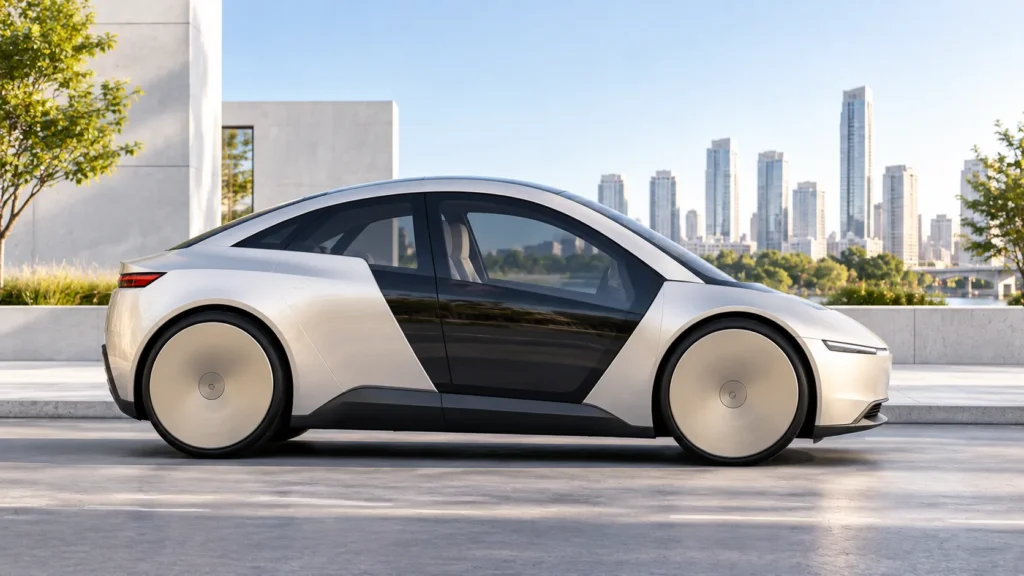
There are two different prices to consider: the cost of taking a Cybercab ride and the price of buying a Cybercab.
Cybercab Ride Price
Tesla does not publish one fixed Cybercab fare on its Cybercab FAQ. Instead, the Robotaxi app displays an estimated price before the passenger confirms the trip. Tesla also says Robotaxi pricing can change.
That means readers should not treat figures circulating online as a permanent official Cybercab fare.
Tesla’s terms state that ride charges are shown in U.S. dollars in the Robotaxi app and can include applicable tolls, airport fees, regulatory charges and similar costs.
Bottom line: there is currently no single official Cybercab price per ride that applies to every trip. The fare shown in the Robotaxi app is the relevant price at the time of booking.
Cybercab Vehicle Price
Tesla has not announced a normal consumer purchase price for the Cybercab.
Tesla’s current support page does, however, provide a route for parties interested in purchasing a fleet or an individual Cybercab for commercial purposes to contact the company. That is different from offering the Cybercab as a normal consumer vehicle for sale.
The frequently repeated $30,000 figure should therefore not be presented as the current Cybercab price.
📌 Read more:
- Tata Aeris 2026 Price, Specifications, Features, Variants and Mileage
- Mahindra XUV 3XO REVX EDGE Launched: Price, Features & Specs
- Tata Sierra Legend Series Launched: Price, Features and Variants
- Mahindra Thar Facelift 2026: Price, Features, Specifications and What’s New
- Tesla Cybercab Robotaxi Launches in Austin: Price, Features & How It Works
- Kia Sorento 2026 Price, Features, Specifications and Launch Detail
Tesla Cybercab Features
| Feature | Tesla Cybercab |
|---|---|
| Seating | Up to 2 passengers |
| Steering wheel | No |
| Accelerator pedal | No |
| Brake pedal | No |
| Vehicle type | Purpose-built autonomous robotaxi |
| Powertrain | Electric |
| Autonomous technology | Tesla autonomous-driving technology |
| Current Cybercab service | Limited areas of Austin, Texas |
| Traditional onboard driver | No |
| Passenger controls | Central touchscreen and Robotaxi app |
| Remote support | Tesla Robotaxi Support available |
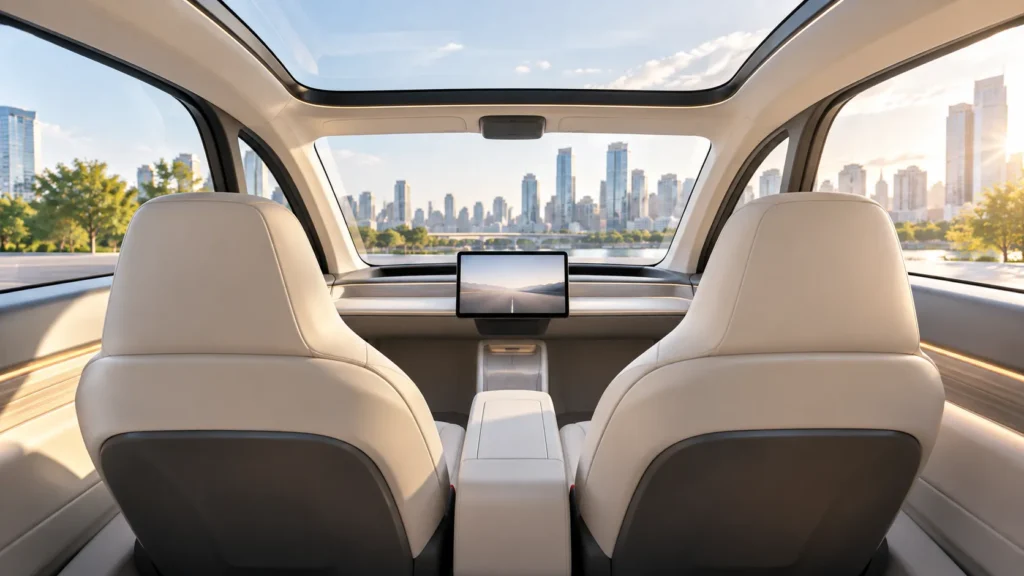
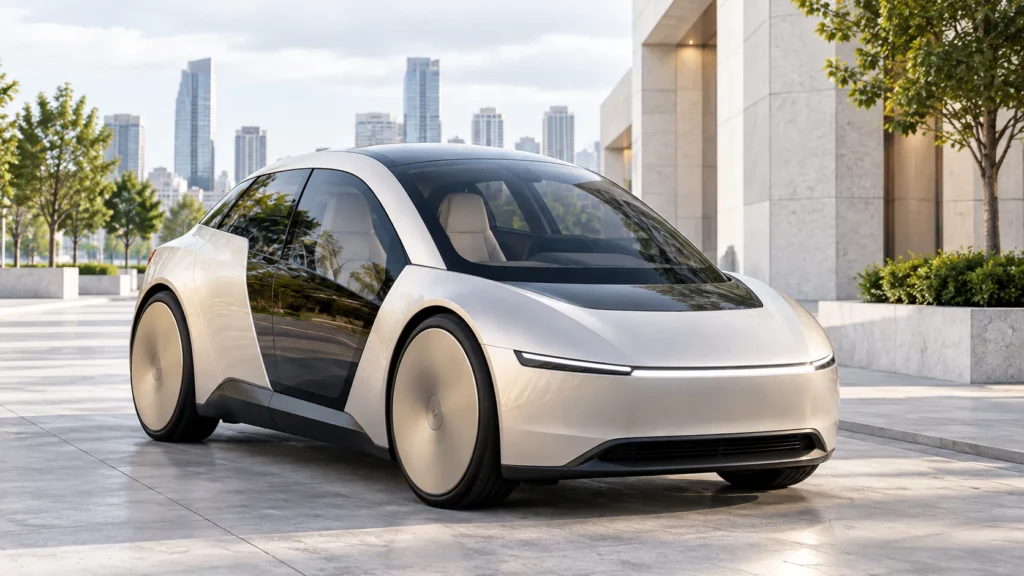
Tesla’s official Rider Guide confirms that the Cybercab has two seats and is not equipped with a steering wheel, accelerator pedal or brake pedal. It also includes a central touchscreen, cabin camera, USB-C ports and passenger-focused controls.
Tesla lists the Cybercab’s rear trunk at 20.2 cubic feet and says it can accommodate combinations such as two checked bags and two carry-ons.
📌 Discover more: EV vs Petrol Cars in India: Which Saves More Money in 2026?
Why Does Cybercab Have No Steering Wheel or Pedals?
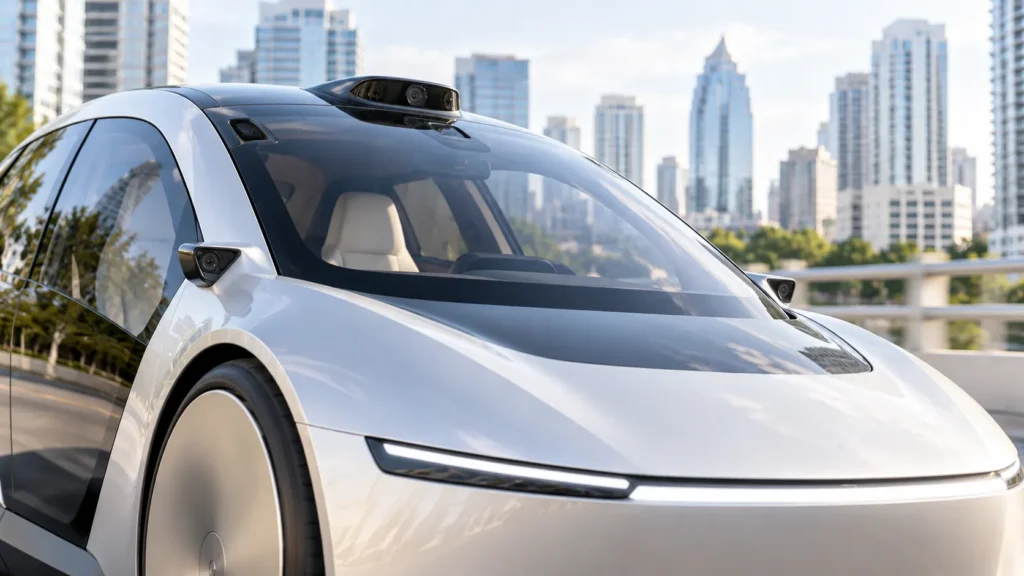
The absence of conventional driving controls is arguably the most important physical difference between Cybercab and a normal Tesla.
The Cybercab is not designed around the idea that a human might take over during a journey. Tesla built it as an autonomous transportation vehicle, with passengers sitting in a cabin rather than occupying a traditional driver’s position.
The cabin has two seats, a central touchscreen and automated functions for doors, climate controls and the ride itself. Passengers start the trip from the touchscreen after they are seated and buckled.
That design has an important regulatory consequence, however. Conventional vehicle regulations were developed largely around vehicles containing human-operated controls. A vehicle that has no steering wheel or pedals therefore creates questions about how existing federal safety standards apply.
That issue is now part of NHTSA’s examination of Tesla’s Cybercab certification.
How Does Tesla Cybercab Work?
The Cybercab experience is designed to be relatively simple for passengers:
1. Request a ride
The passenger opens Tesla’s Robotaxi app, enters a destination and receives the estimated fare and wait time.
2. Wait at the designated pickup location
Tesla’s app identifies when the vehicle is approaching. The Cybercab’s exterior lightbars can help passengers identify the correct vehicle.
3. Enter the vehicle
The passenger can use either seat. Tesla says the door can automatically open when the Cybercab detects the ride requester’s phone.
4. Start the trip
Once passengers are seated and buckled and the doors are closed, the rider starts the journey using the touchscreen.
5. Autonomous driving
The vehicle handles steering, acceleration, braking, navigation and other driving tasks without an onboard human driver. Tesla says Cybercab uses camera vision and sensors to navigate city streets, highways, intersections and parking areas.
6. Human support remains available
The absence of a driver does not mean the passenger is completely disconnected from Tesla. Cybercab includes a support function that allows riders to contact Tesla Robotaxi Support. The vehicle also has a two-way communication system and cabin camera that can be accessed by support personnel in certain circumstances.
7. Arrival
At the destination, the vehicle parks and the passenger can open the door through the touchscreen or door controls. This distinction matters: remote support is not the same thing as a human driver sitting in the vehicle.
📌 Read more:
- 2025 Hyundai Aura SX: Ultimate Review of Features & Mileage
- Best EVs Under ₹20 Lakh in India 2026: Top Budget EV Cars
- Big Savings: Toyota Cars Get Cheaper in India After GST 2.0
- BMW X6 M60i xDrive Launched in India: Price, Features, V8 Performance & Full Review
- EV vs Petrol Cars in India: Which Saves More Money in 2026?
- EVs Under ₹20 Lakh Comparison, Top Electric SUVs Feature, Price & Range
Is Tesla Cybercab Fully Autonomous?
In operational terms, the Cybercab is being deployed as a driverless robotaxi. There is no traditional human driver inside the vehicle.
Tesla itself describes Cybercab as designed for full autonomy and says its lack of a steering wheel and pedals is possible because the vehicle is fully autonomous.
However, it would be misleading to interpret the Austin deployment as proof that Tesla has achieved unrestricted Level 5 autonomy everywhere.
The service currently operates within defined geographic limits, under Tesla’s Robotaxi service structure. Riders also have access to Tesla support, and the vehicle is designed with systems for emergency assistance and remote support.
A useful way to understand the current situation is this: Cybercab is operating without a human driver in a limited commercial environment, but that does not mean Tesla has demonstrated unrestricted autonomous driving under every road, weather and regulatory condition worldwide.
📌 Discover more: Tata Harrier Stealth Edition & Tata Safari Stealth Edition
Tesla Cybercab Safety and NHTSA Investigation
The biggest regulatory development surrounding the launch came almost immediately afterward.
On September 4, 2026, NHTSA announced that it had opened an Audit Query into Tesla’s self-certification of Cybercab. The agency said it is examining Tesla’s certification that the new vehicle meets applicable Federal Motor Vehicle Safety Standards.
Reuters reported that the review involves approximately 1,000 Cybercabs and centers on the unconventional design and Tesla’s certification approach.
The important point is that an NHTSA investigation does not by itself mean that Cybercab has been found unsafe or that Tesla has been found to have violated the law.
Instead, regulators are examining whether Tesla’s certification complies with federal requirements.
NHTSA is the U.S. federal agency responsible for enforcing vehicle safety standards and investigating potential compliance problems.
The Cybercab’s steering-wheel-free and pedal-free design makes the regulatory question particularly important. Tesla has effectively moved the human driver out of the vehicle, while the vehicle itself must satisfy safety requirements originally developed largely around conventional automobiles.
That makes regulatory acceptance one of the biggest factors determining how quickly Cybercab can expand.
📌 Discover more: Tata Tiago EV 2026 Review: Price, Range, Features & Charging
Tesla Cybercab vs Waymo Robotaxi
Tesla and Waymo are taking noticeably different approaches to autonomous ride-hailing.
| Feature | Tesla Cybercab | Waymo Robotaxi |
|---|---|---|
| Autonomous service | Yes | Yes |
| Human driver | No | No |
| Steering wheel | No in Cybercab | Vehicle/platform dependent |
| Lidar | Tesla’s approach emphasizes cameras and vision | Yes |
| Radar | Tesla’s current Cybercab approach is camera/vision focused | Yes |
| Vehicle strategy | Purpose-built Cybercab | Multiple vehicle platforms |
| Current deployment | Limited Cybercab service in Austin | Commercial service across multiple U.S. markets |
Waymo says its autonomous system combines lidar, cameras and radar with AI software. Its sensor architecture is designed to create a detailed view of the vehicle’s surroundings.
Tesla, by contrast, has pursued a much more camera-and-AI-focused strategy. Tesla’s Cybercab documentation says the vehicle uses camera vision and sensors to navigate its environment.
Neither strategy should automatically be described as universally safer based solely on the hardware configuration. Real-world safety depends on the complete system, including perception, software, vehicle control, operating conditions, human interaction and regulatory oversight.
What Makes Cybercab Different From a Normal Tesla?
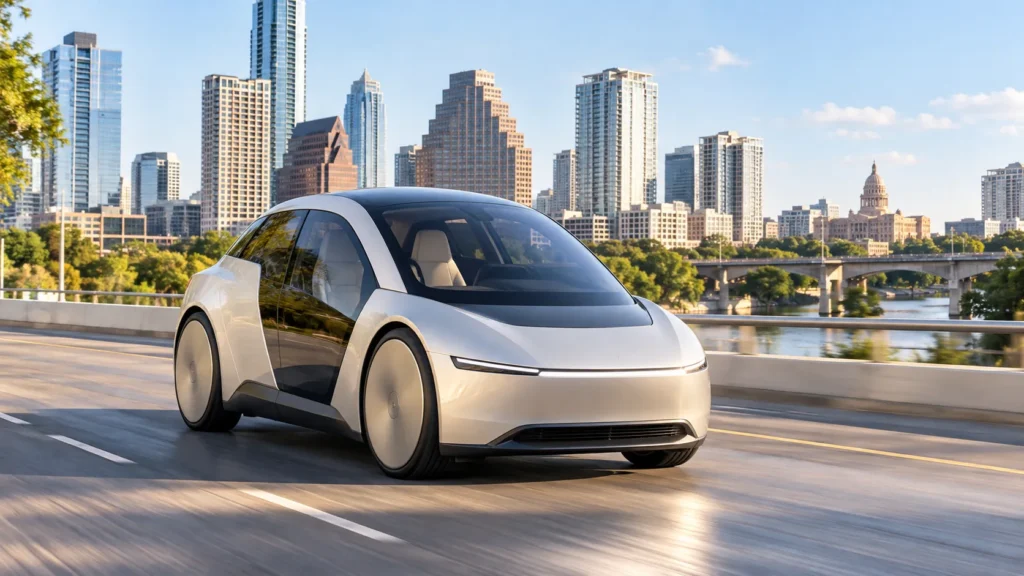
Cybercab is fundamentally different from a Model 3 or Model Y running Tesla’s driver-assistance software.
A conventional Tesla is built around a human owner who can operate the vehicle. Cybercab is designed around a fleet-service model in which passengers are customers rather than drivers.
Its two-seat layout, lack of steering controls and dedicated passenger interface reflect that difference.
Tesla’s broader strategy is also significant. Instead of treating autonomous driving purely as a feature sold to individual vehicle owners, the Cybercab allows Tesla to build a dedicated transportation service around autonomous vehicles.
That could potentially reduce operating costs by eliminating the need for an onboard driver, while allowing vehicles to operate as part of a centrally managed fleet.
But that economic model only works at scale if Tesla can demonstrate reliable autonomous operation, maintain vehicles efficiently, secure regulatory acceptance and generate enough rider demand.
📌 Discover more: Tata Punch Facelift 2026 vs Tata Punch EV 2026
When Will Tesla Cybercab Expand to Other Cities?
Tesla has not announced a definitive global Cybercab rollout schedule.
Its broader Robotaxi service is already operating in limited areas of Austin, Dallas, Houston, Miami, Orlando and Tampa using Model Y and Cybercab vehicles. Tesla says Robotaxi is expected to expand to additional cities in the coming months.
However, readers should distinguish between Tesla’s Robotaxi expansion plans and a confirmed Cybercab launch in a particular city.
Regulatory approval, vehicle certification, local autonomous-vehicle rules, operational readiness and fleet availability can all affect the timing.
For markets outside the United States, there is currently no confirmed Cybercab consumer launch date that should be treated as official.
Can You Buy a Tesla Cybercab?
Not as a normal consumer Tesla vehicle at this point.
Tesla’s current Cybercab support information does not provide a consumer retail price or standard ordering process. It does, however, invite interest from buyers seeking a fleet or individual Cybercab for commercial purposes.
That suggests Tesla is currently treating Cybercab primarily as a robotaxi/fleet product rather than another conventional Tesla model sold through its normal consumer lineup.
Whether individual consumers will eventually be able to buy one remains an important unanswered question.
Tesla Cybercab Pros and Cons
Potential advantages
- Purpose-built autonomous vehicle
- No onboard human driver
- Compact two-passenger configuration
- Electric powertrain
- Passenger-focused cabin
- Fleet-based operation
- Potentially lower operating costs without a driver
- Designed for continuous ride-hailing use
Current challenges
- Cybercab availability remains geographically limited
- NHTSA is examining Tesla’s certification
- Autonomous-driving performance still requires real-world validation
- Steering-wheel-free design creates regulatory questions
- Deployment is much smaller than Tesla’s long-term ambitions
- Expansion depends on local regulations and fleet readiness
Tesla Cybercab: Should You Be Excited?
Cybercab deserves attention because it represents a change in Tesla’s autonomous-driving strategy.
For years, Tesla’s autonomy story was primarily connected to cars that people personally owned. Cybercab takes a different approach: build the vehicle specifically around autonomous transportation and operate it as a service.
That is a much bigger shift than simply adding another software feature to a Model Y.
But the Austin launch should also be viewed in context. It is an early commercial deployment, not proof that autonomous transportation has been completely solved.
Tesla still needs to demonstrate that Cybercab can operate reliably across a much wider range of conditions and locations. It also needs to navigate regulatory scrutiny, expand its fleet and convince passengers that riding without a steering wheel or human driver is safe.
The NHTSA review makes that last point especially important. The investigation is not a verdict against Cybercab, but it demonstrates that the regulatory framework is still catching up with Tesla’s vehicle design.
For now, Austin is the proving ground. What happens there could determine whether Cybercab becomes a genuinely scalable transportation platform – or remains a limited showcase of Tesla’s autonomous-driving ambitions.
📌 Read more:
- Why Maruti Suzuki Victoris 2025 is a Smart & Perfect Choice
- Volvo EX30 2025 Review: Price, Range, Features & India Launch
- Volkswagen Tayron Review: A Premium 7-Seater SUV with Powerful Performance
- Volkswagen Taigun Review 2026 – Real Experience, Price & Worth Buying or Not?
- VinFast VF6 and VF7 – New Electric SUVs Launched in India
- Upcoming SUVs in India 2025: Amazing Tata, Renault & Nissan
Tesla Cybercab 2026 FAQs
Q1. Is Tesla Cybercab available now?
A1. Yes. Tesla says Cybercab rides are currently available in limited areas of Austin, Texas.
Q2. Where can you ride a Tesla Cybercab?
A2. Cybercab-specific rides are currently available in limited areas of Austin. Tesla’s broader Robotaxi service also operates in parts of Dallas, Houston, Miami, Orlando and Tampa, although availability and vehicle type vary by market.
Q3. How much does a Tesla Cybercab ride cost?
A3. Tesla does not publish one fixed Cybercab fare. The Robotaxi app displays the estimated fare before the passenger confirms the ride, and pricing can change.
Q4. Does Tesla Cybercab have a steering wheel?
A4. No. Tesla’s official Rider Guide confirms that Cybercab does not have a steering wheel.
Q5. Does Cybercab have pedals?
A5. No. The Cybercab has no accelerator or brake pedal because it is designed to operate autonomously.
Q6. Is Tesla Cybercab fully autonomous?
A6. Cybercab is being operated as a driverless autonomous robotaxi, and Tesla describes it as designed for full autonomy. However, its current service is limited in geography and operation, so the Austin deployment should not be interpreted as unrestricted Level 5 autonomy everywhere.
Q7. Can you buy a Tesla Cybercab?
A7. Tesla is not currently offering Cybercab as a normal consumer vehicle with a published retail price. Tesla does accept commercial interest for fleet or individual commercial purchases.
Q8. Is Tesla Cybercab safer than a human-driven car?
A8. There is not enough independent evidence to make a blanket claim that Cybercab is safer than human driving in every situation. NHTSA is currently examining Tesla’s self-certification, and the regulatory review should not be interpreted either as proof of safety or proof of unsafe operation.
Q9. When will Cybercab launch outside Austin?
A9. Tesla has not announced a definitive Cybercab launch date for other cities or countries. Its broader Robotaxi service is expanding in the U.S., but Cybercab-specific expansion should be treated as future plans unless Tesla confirms a particular market.
Final Takeaway
The Tesla Cybercab has moved beyond the concept stage and into limited real-world robotaxi operation in Austin. Its two-seat cabin, lack of steering wheel and pedals, autonomous driving system and fleet-focused business model make it one of Tesla’s most ambitious vehicles yet.
But the launch is only the beginning. Tesla must prove that the technology can scale safely and reliably, while regulators determine how a vehicle with no conventional driving controls fits within existing safety standards.
For consumers, the most important facts today are simple: Cybercab rides are available in limited areas of Austin, the ride price is shown dynamically in Tesla’s Robotaxi app, there is no confirmed consumer purchase price, and NHTSA is examining Tesla’s certification of the vehicle.
That makes Cybercab an important autonomous-driving milestone – but not yet the final form of driverless transportation Tesla has promised.
Disclaimer: Product prices, features, and specifications mentioned on this website may change without notice. Please check the official brand website or trusted retailers for the latest updates before making any purchase.
Related Posts
- Tata Aeris 2026 Price, Specifications, Features, Variants and Mileage

- Mahindra XUV 3XO REVX EDGE Launched: Price, Features & Specs
- Tata Sierra Legend Series Launched: Price, Features and Variants

- Mahindra Thar Facelift 2026: Price, Features, Specifications and What’s New
- Tesla Cybercab Robotaxi Launches in Austin: Price, Features & How It Works
- Kia Sorento 2026 Price, Features, Specifications and Launch Detail
- Toyota Hilux 2026 Review, Price, Features, Performance & Should You Buy It?
- EVs Under ₹20 Lakh Comparison, Top Electric SUVs Feature, Price & Range

Latest Bike
- Jawa 42 All Stars Launched in India: Price, Specs & Features

- Electric Bike vs Petrol Bike: Pros, Cons & Ownership Cost 2026
- Tesla Balance Bike for Kids: Price, Features, Specifications & Why It Sold Out Instantly
- Yamaha Aerox E Price, Range, Features, Specifications & Review
- Revolt RVX Review 2026: Price, Range, Specifications, Features & Is It Worth Buying?

Wasiur Rehman is a content writer with a focus on technology and automobiles, covering smartphones, gadgets, EVs, and car-related updates. He writes clear and informative articles designed to help readers stay updated with the latest launches, features, and industry developments.